Life lessons from Stav - Part 6 - The Key
Published: Mon, 06/29/26
Life lessons from Stav – Part 6 – The Key
Is there a key text which brings us the deepest and most fundamental understanding of the runes?
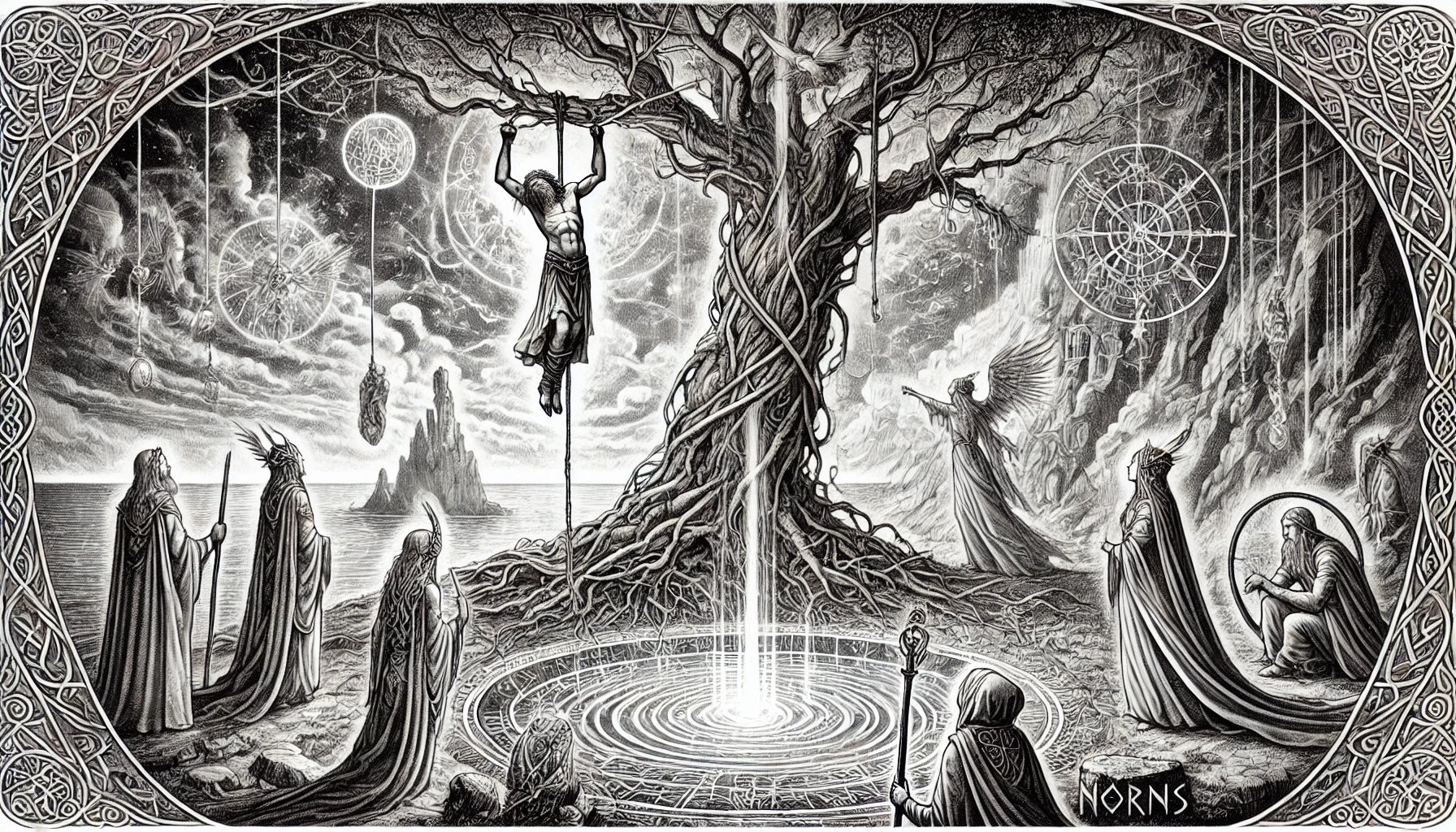
In the Poetic Edda there is one particular poem known as the Havamal. This title is variously translated as: 'The Sayings of the High one', or, 'The sayings of the one eyed one'. Either way this poem is attributed to Odin as his collection of sayings, teachings, a partial account of his adventures, particularly of a romantic nature, and advice for living, especially in matters of hospitality.
There are a total of 164 stanzas and there are all worth reading. However, it seems that the Havamal is actually a collection of maybe 6 different works of which 8 verses make up a section known as the ‘Runatal’ or 'Tally of the Runes' (Stanzas 138 to 145). Stanzas 138 and 139 describe a shamanic ordeal in hich the author says that he hung for nine nights on 'a high windy tree' without food or drink. Eventually he took up the runes, learned nine spells and won a drink of mead which may be another word for inspiration. In stanza 141 the writer describes that he now has wisdom and inexhaustible creativity which flows from him in both word and deed. Stanza 144 poses a series of questions which any practitioner of the runes should ponder beginning with:
Do you know how to cut/carve/write them?
Do you know how to read/interpret them?
Stanza 145 concludes the Runatal with the reminder that; 'A gift always looks to a gift' and it is sometimes better not to ask for anything than to have to make too great a sacrifice in return. We do not know who contributed to the Havamal or even when they lived. However, I am seeing a clear message for our own time in this passage.
A day does not pass without some reference to our latest technological toy which we refer to as AI, computer programmes which appear to simulate a form of intelligence. Not that anyone can fully define what intelligence is anyway. A great deal of capital is being invested in ‘AI’ technology including the building of giant power hungry data centres which we are told are in order to run the AI programmes and cope with the vast amounts of data involved. It is predicted that AI will make human thought and creative work obsolete as books, films, pictures, music and songs can all be created almost instantly by AI. So, who needs authors, artists, musicians or poets any more? So, is the only purpose of human beings now to consume the material generated by AI? Lets think about the implications here.
Firstly, we are now living in two parallel worlds. I wrote the first draft of this article on paper with a pen while sitting in a wood for the midsummer camp at Silver Forest. I re-read the Havamal text in two different translations which I had with me in paper book form. This article was conceived in a carbon based brain while I sat writing surrounded by carbon based trees under a blue sky dotted with H2O based clouds. AI has no knowledge or experience of such a process and this article did not exist in the silicon based world until I typed the words into a silicon based computer and uploaded the digital data to the silicon world of the internet where AI believes that it is king. Secondly, over the past 25 or so years, a silicon based world of interconnected computers and data storage facilities has been created and vast amounts of human generated data, which previously would have existed in books and other paper mediums, in celluloid, on canvas, vinyl, analogue tapes etc, has been digitised and uploaded to the silicon realm. Search engines and desk top publishing amongst other systems have been developed in order to locate, access, and process this data. What we now call AI is just extremely powerful search and processing systems which have been developed from the the earlier forms of Information technology. The modern systems can respond to specific instructions, scavenge the web looking for data, and then assemble it according to the instructions given.
If you were to ask an AI programme to write an article on runes it could do so using readily available material on the internet, including quite possibly my own writings on the subject. This is a very quick and easy way of putting together a competent piece of writing with absolute minimum effort. I have seen an estimate that this kind of AI generated stuff makes up about 80 percent of top search results. In fact AI searches show a preference for material generated by AI systems such as Claude or Chat GTP. What’s not to like? 1. Using AI is quick, easy, and cheap, just how we like things in the modern world. The English will probably be even better than I can manage when I write in the carbon world.
Lets go back to Stanza 145 which reminds us that whatever gift AI may bestow on us something is going to be demanded in return and the sacrifice may turn out to be greater than we can afford to pay.
We may have just lived through a brief period when we might just get something reasonably sensible out of AI simply because the programmes are scavenging data from first generation sources which were created by carbon based minds working in the ‘real carbon based world’. The reality I am writing this in has finite limits of time and space. Although I can imagine pretty much anything I want, I am also aware of the physical limitations of reality. Because AI only exists in the digital/silicon universe it knows no such limits. A first generation mash-up of pre-existing material may seem quite clever and even original. However, as the AI begins to feed off its own creations, or more accurately, combinations, what is produced will have no relevance to anything we know or understand in our carbon based world. Either the digital world becomes meaningless and useless for any practical purpose. Or we immerse ourselves in the digital silicon universe and almost leave this one behind Matrix style.
In Stanza 141 Odin speaks of enhanced imagination, a gaining of wisdom, and creative achievements flowing effortlessly in words and deeds. This expansion of consciousness was the reward for the suffering and patience endured as described in Stanza 138. True creativity comes at a price which needs to be paid upfront with study and a willingness to suffer the doubt, fear, and uncertainty which goes with the time and effort needed for genuine creative efforts and results. Some people may enjoy a brief period of quick and easy creativity delivered by AI. The price will be a descent into absurdity as data which may make some kind of sense in a silicon universe becomes less and less relevant to the carbon based world we actually live in. True creativity and profound wisdom is our birthright. However, we need the courage and determination to claim it and we need to be willing to pay the price.
1.Bonner Private research, what AI won't do
PS If you really want to know how and why the runes originated and developed come and meet Roland Zerpe at Stavcamp in September
21 Beaver Road
Beverley East Yorkshire HU17 0QN
UNITED KINGDOM
Unsubscribe | Change Subscriber Options