Life Lessons from Stav Part 3 - The Five Principles for Self-defence
Published: Wed, 05/20/26
Updated: Wed, 05/20/26
The Five Principles for Self–defence
Last Sunday I took part in a fairly large martial arts seminar which is held each year in Bridlington. I have attended for the past 3 years as a participant to support my Kung Fu teacher. However, this year I offered my services as an instructor and taught two sessions which was quite an honour. One session involved quite young children, which I must admit was challenging and next time I will handle it slightly differently. However, the adult session seemed to go pretty well and the organiser has told me I will be welcome back to teach again next year.
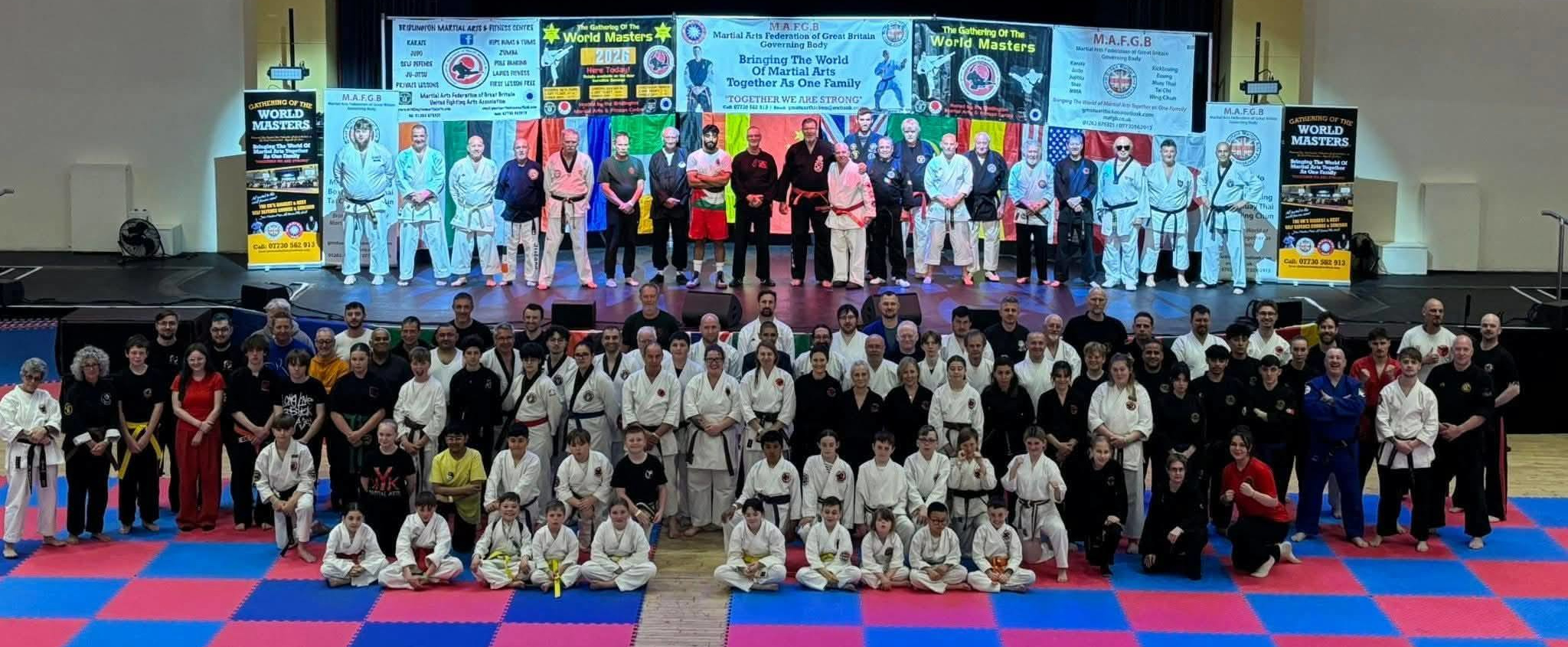
Atendees and Instructors at the Bridlington Masters Seminar 2026
When teaching at this kind of multi style event I do my best to consider three things:
1. How do I offer something that is specific, if not unique to my style and approach to training?
2. How do I offer something that can be taken away and incorporated into someone else’s training, if they wish to, from a 40 minute session?
3. How do I make my training safe and reasonably comprehensible to those who participate in my session? The majority of people at such a seminar will have some, maybe even a lot, of martial arts experience. On the other hand someone with Karate expertise will have a very different skill set to, say, a BJJ enthusiast.
In Stav we have the stances and the idea of working with the web of Orlog. However, the stances are hardly relevant to someone who is just going to spend 40 minutes training with me. The web is a fascinating concept, with many possibilities for close quarter combat and breaking balance etc. Again, this would be difficult to explore in 40 minutes. Over the years I have led a great many one off, or short series, training sessions, particularly at various camps, and I have found that a basic introduction to the five principles, or at least the first three, goes down well and seems to fulfil the three requirements outlined above.
When I began learning Stav in 1992 Ivar was teaching with the Jo (short staff) and Boken (Japanese training sword). The five principles drills were taught using the Boken for attacks, and the Jo for the different defences. Then, as time went on we looked at interpreting the five principles using other weapons such as the axe, spear, and cudgel as well as unarmed applications. The five principles have names which come from the Norse mythology, specifically the Rigsthula or the Story of Rig The Walker who came to Midgard, our world to father the different classes of men. This story in referred to in the first verse of the Voluspa when the poem is addressed to: ’Heed my words all classes of men, you greater and lesser children of Heimdall.’ (Translation by Jackson Crawford).
The ‘children of Heimdal’ are; Trel, the peasant or slave. Karl, the freeman or farmer, and Jarl, the Lord and warrior. We also have Hersir, Jarl’s father-in-law, and Jarl’s son Kon or Konge who was apparently the first king of Denmark. From a martial arts point of view each principle provides a strategy for dealing with a conflict situation. This approach seems to be pretty unusual, if not unique in martial arts training. There were some very skilled people teaching at the weekend. However, the approach to self defence always seems to be: Someone starts on you give them a good hiding. I am not going to criticise anyone else’s teaching, however, there might be something to be said for a more nuanced approach to self-defence. Many years ago I attended a brilliant weekend seminar with Marc McYoung in Bristol. Mr McYoung stated that martial arts ability can get you into a lot of trouble when it doesn’t work in the real world, and into even more trouble when it does work. Even if someone else attacks you and your self-defence in perfectly justified it is very easy to end up with a charge of using ‘excessive force’ if your assailant suffers even minor injuries and decides to press charges. Don’t imagine that the police will be ‘on your side’ just because you were the victim on an attack. The criminal classes are actually very experienced in manipulating the forces of law and order for their own benefit. A physical attack may well turn out to be the least of your worries if you defence yourself by inflicting damage on your attacker. By the grace of God I have never personally put myself in such a situation. However, it has certainly happened to friends of mine.
From a self-defence point of view the first three principles, Trel, Karl, and Hersir, are usually the most relevant. If a conflict situation is really not your problem and you will derive no benefit from getting involved you need to see yourself as being in the Trel role. Your only priority is to remove yourself from the situation with as little fuss as possible. If the problem is someone attempting to enter your space which is your responsibility to protect then you are in a Karl role and you need to prevent the unwarranted entry. If it is your job to maintain order and restrain, or remove, trouble makers then you are in the Hersir role and you should act with authority, training, and preferably, assistance. The Jarl role involves keeping a detached overview of the situation and the Konge is willing to take extreme risks to defend others when there is no choice in the matter.
I can teach the five principles using a wide range of teaching methods depending upon the student’s level of competence with various weapons. For events such as the seminar on Sunday I start off with a wrist grab and then deal with it from a Trel, Karl, and then Hersir point of view. I then started on some Five Principles Knife Defence . However, on this occasion we only had time to get to the Karl drill. Hopefully I managed to communicate the idea that a measured and appropriate response to a conflict situation is better than just beating the ‘c***p out of an assailant, however much he might seem to deserve it.
The five principles are also fundamental to the organisation and structure of society and I will elaborate on this aspect in a future post.
Regards
Graham
PS If you want to learn Stav then there is really no better opportunity than Stavcamp in September 2026.
21 Beaver Road
Beverley East Yorkshire HU17 0QN
UNITED KINGDOM
Unsubscribe | Change Subscriber Options